
"I started out growing flowers solely for prettiness, like both my grandmothers and a dear English gardener neighbour. As time passed, I grew to love seeing all the native bees, bugs, caterpillars, and butterflies on my native plants. I began adding plants from lists of perennials and annuals that were rich in nectars, to attract both butterflies and hummingbirds. This lead to learning more about habitat loss, and I added host plants for specialist caterpillars with specific evolutionarily-matched needs. This led into ever “messier”, more naturalized gardening - leaving the leaves, keeping flower seed heads up all winter to feed the birds and give homes to overwintering insects.
I started over in 2022, when we moved back into my childhood home, by planting several native woody plants: a stately tulip tree, a skinny and short (for now) red oak, a wild black cherry, and eight tiny ill-fated serviceberry saplings, which the groundhogs ate. I lost track after we moved the 10th carload of mostly native plants from our previous, much larger gardens to these ones. Our previous home had an extensive brush pile and a critter cam. It was fun to watch the skunks and other critters use "the heap". Since then I have planted hundreds more native plants and shrubs. The incredible lushness of the new beds makes it truly hard to believe:
A) that this was a largely lifeless lawn in 2022, with a border of non-native flowers along the hidden, invasive non-native privet hedge to the right (west) of this picture.
B) that it is made up of three brick-edged beds each roughly 4' x 8' in size.
C) that the three or so trees behind the clothesline pole are Redbuds of unusual size. (Cercis canadensis, often nicknamed dead-buds for their short lifespans.)
D) that our young Tulip tree (Liriodendron tulipfera) in between the clothesline, wood fence, and metal arbour, will soon tower over all the established neighbouring trees.
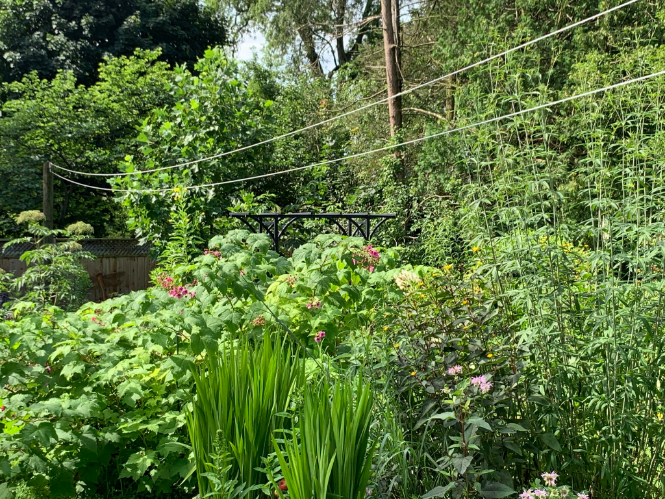
Photo: Heather Phillips
I still need to replace many non-native shrubs and to eradicate large swaths of invasive periwinkle, but I look forward to turning this into even more of a pollinator paradise. Already, in its 3rd summer, it is attracting many species that I had not seen here before. The fireflies alone are magical enough to be utterly worth the effort of planting!"